


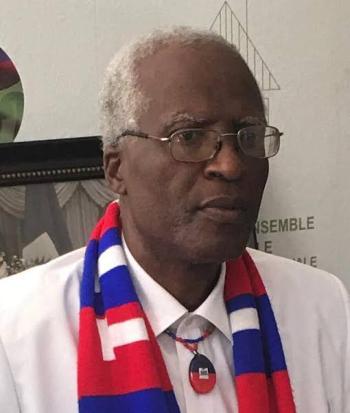
Photo of Reverend Pastor Wilson André.
By Junior Pierre, Satellite 509, Oct. 23,2026
The search for a solution to the Haitian crisis continues to generate debate in various sectors of society. On Friday, October 23, 2026, the Interreligious Platform for Peace and the political group Alliance of Upright, Competent, and Anti-Corruption Patriots (PICA) both advocated for a dual executive, while denouncing the insufficient results of the transition led by Prime Minister Alix Didier Fils-Aimé.
At a press conference, Reverend Pastor Wilson André, speaking on behalf of the Interreligious Platform for Peace, stressed the need for dialogue among the various sectors of national life to find a lasting solution to the crisis. According to him, the gravity of the situation demands collective awareness, as the population continues to suffer the consequences of armed group violence and the deterioration of their living conditions.
Describing the current transition as a "total failure," Wilson André called on Prime Minister Alix Didier Fils-Aimé to resign. He also urged those willing to contribute to the country's recovery to take responsibility. In this context, the Interreligious Platform for Peace advocates for the establishment of a dual executive, which it presents as a possible solution to the crisis.
For its part, the PICA political coalition also criticized the current administration. At a press conference, its secretary general, Dr. Jean Ardouin Louis Charles, denounced the government's inability to provide concrete solutions to the difficulties facing the country. According to him, the Prime Minister lacks the necessary qualities and skills to lead Haiti out of its current predicament.
The political leader also called on the state to regain control of territories occupied by armed groups. This demand comes as insecurity continues to disrupt the daily lives of many Haitians and weaken the functioning of public institutions.
Furthermore, Jean Ardouin Louis Charles accused the Prime Minister of wanting, in his words, to empty the state coffers while the population faces persistent poverty. This statement reflects the concerns expressed by PICA regarding the management of public resources, in a context marked by the scale of social and security needs.
Despite their different affiliations, the Interreligious Platform for Peace and PICA agree on several points: the need for a change in the conduct of public affairs, the restoration of security, and the search for a new governance model. However, while both organizations call for a dual executive, the modalities of its implementation and the conditions of its operation remain to be defined. Their positions thus illustrate the persistent disagreements surrounding the transition and the pressure exerted on the authorities to provide solutions to the multidimensional crisis facing Haiti.
Posted Nov. 5, 2026