


By Chris Martin, Martin Group International LLC, August 24, 2026
This article is written from the perspective of an operational practitioner with experience in foreign internal defense, security force assistance, and stability operations. It deconstructs the strategic transition from tactical conflict to political governance in low-intensity asymmetric theaters.
1. The Realpolitik of the Endgame
The Western foreign policy establishment consistently falters in low-intensity conflicts because it treats military intervention as an isolated exercise in kinetic dominance. Planners routinely measure progress by body counts, weapon seizures, or the temporary containment of strategic intersections. They operate under the illusion that "regime change" is a single, dramatic event enforced by a foreign decree or an engineered transitional council.
They fail to grasp a foundational truth of strategic doctrine famously codified by B.H. Liddell Hart and rooted in classical antiquity: the ultimate purpose of war is to achieve a better peace.
War is not an open-ended loop of violence conducted for its own sake. It is a violent political instrument used to shatter an opponent's structural stability, destroy their political will, and force a new governance architecture on the victor's terms. True regime change on an asymmetric battlefield is not an artificial civilian ceremony; it is a slow, mathematical transition driven by the physics of territory control, time, and population-centric survival. When the dust settles, the actor who successfully dictates the terms of the peace assumes the absolute mandate of the state.
2. The Dialogue Gauntlet as an Offensive Weapon
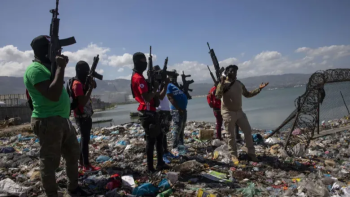
This strategic law completely recontextualizes the political maneuvers of the unified irregular coalition, Viv Ansanm, in Port-au-Prince. When a non-state armed actor steps forward to issue a formal dialogue challenge—publicly stating, "We want dialogue, because we want peace; those who don’t want dialogue always rely on war"—they are not surrendering. They are executing a sophisticated transition from tactical street defense to advanced statecraft.
They are weaponizing the call for peace as a strategic offensive lever. By explicitly framing their armed rebellion as a historic continuation of the 19th-century Cacos and Piquets uprisings, the irregular front effectively strips the unelected state apparatus of its remaining moral authority. They present an unyielding challenge to the Transitional Presidential Council (TPC) and its external Core Group managers:
- The Semantic Trap: If the foreign-backed administration accepts the dialogue, they admit that their top-down security apparatus is powerless to pacify the terrain, effectively co-signing the irregular front's de facto authority.
- The Unmasking of the Occupation: If the administration rejects the call for an inclusive national dialogue, they expose their own intervention as an unconstitutional occupation force designed to maintain a state of permanent instability rather than stabilization.
By forcing this dilemma, the irregular coalition shifts the conflict from a war of bullets to a war of political legitimacy. They understand that by holding 85% of the capital, they do not need to win a conventional military victory to achieve regime change; they only need to dictate the conditions under which the guns fall silent.
3. Drone Warfare and the CIVCAS Trap: Why Top-Down Interventions Collapse
The fundamental reason this asymmetric transition succeeds is that true stability can never be forced from the top down. The current intervention blueprint relies heavily on the Global Security Framework (GSF) and its specialized Gang Suppression Force (GSF)—a heavily armed, outsourced kinetic element designed to execute aggressive raids and tactical containments within the urban core.
The most glaring operational failure of this model is the escalating deployment of remote drone strikes within dense residential neighborhoods. While official country teams issue sanitized public relations statements claiming these aerial assets are surgically targeting "gang members," the raw ground truth reveals a devastating surge in Civilian Casualties (CIVCAS).
In a low-intensity urban theater, CIVCAS is the ultimate accelerator of asymmetric defeat. This foundational lesson was central to every single pre-game brief during my three combat rotations in Afghanistan serving on a Special Forces Operational Detachment Alpha (ODA). Before every operation, village clearance, or even conducting humanitarian assistance to the villages our teams were intensely briefed on CIVCAS mitigation metrics because we understood an absolute law of the human terrain: you must have the populous on your side, not on the side of the insurgent.
When a top-down force isolates itself in fortified green zones and drops explosives into congested concrete slums, they commit a fatal doctrinal error. They do not neutralize an adversary; they turn the entire surrounding populace violently against the Haitian government and its international backers. Every civilian killed by a drone strike acts as a force multiplier for the irregular coalition—generating deep communal rage, destroying the last shreds of state legitimacy, and creating an unending pipeline of highly motivated new fighters for Viv Ansanm.
When an intervention force relies on a top-down Gang Suppression Force that isolates itself from the grassroots human terrain—a fatal mistake repeated from the previous UN MINUSTAH footprint straight to the conventional state forces trapped in reactive command boxes in Makurdi and Jos, Nigeria—they create a critical vacuum of state legitimacy. The local population naturally rejects the foreign apparatus.
Just like the Taliban blueprint in Kabul, when the artificial external framework eventually snaps under occupation fatigue and retreats, the embedded irregular front naturally swallows the territory, transforming its material dominance into formal governance.
4. Dismantling the 2026 Administrative Illusion
The ongoing low-intensity friction and tactical GSF operations are pushing the proposed democratic transition toward total systemic paralysis. By relying on heavy-handed kinetic sweeps that alienate local neighborhoods, the unrepresentative proxy administration effectively ensures its own isolation from the human terrain.
The resulting security freeze prevents any baseline territorial consolidation, transforming the political roadmap into an empty bureaucratic exercise. While external managers remain paralyzed by their inability to secure urban corridors without grassroots intelligence, the local coalition leverages its defensive position—using the persistent stasis to completely invalidate the authority of the ghost government while allowing the international community’s institutional momentum to break against the unyielding reality of the streets.
The calculated fallout is that the state architecture remains trapped in a self-perpetuating loop of managed attrition, guaranteeing that the permanent governance structures cannot stabilize before the external clock runs out of momentum.
The Cold Bottom Line
Regime change is the natural terminal phase of a protracted war of attrition. An outsourced, top-down tactical tool like the Gang Suppression Force cannot enforce stability because its entire presence is a superficial mask designed to protect a non-representative elite.
The physics of territory control dictate that time always favors the embedded defensive network. By prioritizing top-down containment and backroom embassy mandates over an authentic domestic settlement, foreign managers ensure that their artificial security apparatus will continue to be defeated by terrain mathematics. The irregular coalition does not need a symmetric military breakthrough to reclaim the nation’s self-determination; they win simply by refusing to be erased and holding the line until the external architecture runs completely out of time. True regime change arrives not when the ballot boxes are printed, but when the actors who command the physical reality of the streets step forward to draft the terms of the peace.
Posted Sept. 9, 2026