


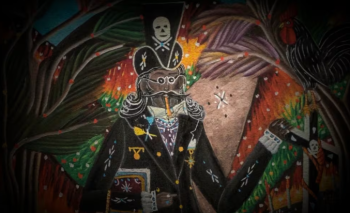
Baron Samedi as depicted by Haitian artist Andre Pierre. (Andre Pierre)
By Daphnée Nostrome, CBC, Oct 28, 2026
Daphnée Nostrome is a Toronto-based systems change leader and artist of Haitian descent whose work centres on cultural revival. She served as a cultural consultant on the documentary Black Zombie.
Hollywood has a long history of stereotyping Haitian spirituality.
In the 1932 film White Zombie, set in Haiti, Bela Lugosi’s sinister sugar mill owner turns the living into zombie labourers using voodoo. Fast-forward to Wes Craven’s 1988 film The Serpent and the Rainbow and a similar scene repeats itself: a soul-stealing witch doctor poisons, then buries the movie’s protagonist alive to turn him into a hapless zombie.
But what Hollywood passes off as “voodoo” is a distortion — beginning with the word itself. Haitians don’t say “voodoo” to describe their spiritual practice, but Vodou. The word comes from vodún, meaning “spirit” or “deity” in the Fon and Ewe languages of West Africa.
Rooted in West African spiritual practices, what would become Haitian Vodou arose in response to the transatlantic slave trade. In the documentary Black Zombie, director Maya Annik Bedward explores this history through the figure of the zombie, tracing its evolution through iconic films, including Night of the Living Dead and The Serpent and the Rainbow.
Black Zombie examines the zombie’s origins as a metaphor to describe how slavery robbed people of freedom, forced them into labour and reduced them to gaunt, disease-worn captives trapped in perpetual bondage. Not fully alive, but not quite dead.
“When I was young, I would hear stories of zombies working in the fields. Personally, I’ve never seen a field worked by zombies. But I know the story,” says Vodou practitioner Yves-Grégory François in French in the documentary.
“Zombification is living under someone’s thumb.”
In the film, Bedward shows how Hollywood recast the zombie as an object of fear, while also distorting and sensationalizing other Haitian spiritual figures and traditions.
Take Baron Samedi. He’s not a skull-faced villain in a top hat, as he’s depicted in the James Bond movie Live and Let Die, or a witch doctor who uses a voodoo doll and strikes a pact with evil spirits, like Dr. Facilier in Disney’s The Princess and the Frog.
Baron Samedi is a lwa or loa (spirit) in Haitian Vodou, the guardian of the crossroads between life and death, and a spirit of resurrection and fertility. He’s also a healer that fiercely protects children from death and illness.
And Voodoo dolls also aren’t a fixture of Haitian ritual practice, though Vodún dolls do serve many ritual purposes in West Africa. “There are dolls that represent a vodún [spirit] and dolls made to heal a person,” says Vodún priest Ayehon Seina Koffi Philippe. They’re not made only to hurt people.
A spiritual practice forged by revolution
The villainization of Vodou goes back at least 235 years. In August 1791, a group of enslaved Africans gathered for the Bois Caïman ceremony, a secret Vodou ceremony and strategic meeting to plan a revolt against their enslavers. The Bois Caïman launched the Haitian Revolution, a 13-year struggle that led to Haiti’s independence from France in 1804.
Demonizing Vodou became part of France’s efforts to “crush Black resistance” during the Haitian revolution, according to theology professor Joseph M. Murphy. In Black Religion and ‘Black Magic’, Murphy writes that colonizers painted Vodou as “a dangerous ‘dark cabal’ and irrational ‘fury,’” and weaponized it to discourage anti-slavery revolts.
Still, Haiti went on to become the first country founded by formerly enslaved people, proving that Black people had the power to end slavery. This shocked slaveholding societies across the world.
Origins of Haitian Vodou
In the 16th and 17th centuries, enslaved Africans primarily from West and Central Africa banded together to resist colonial violence in what would become Haiti. They staged uprisings so they could build a society of their own. African languages and practices were outlawed during slavery, but Africans preserved ancestral memory through oral tradition, herbal medicine, singing, dancing and drumming. These traditions gave them the strength to keep fighting.
These practices mixed with the beliefs of the Taíno people (Haiti’s Indigenous inhabitants) and Roman Catholicism to form Haitian Vodou, a tradition with 21 branches of practice. These branches are called nations or nanchon, and reflect the ethnic groups that shaped Haitian society, like the Ibo, Kongo, Nago and Manding.
This diverse blend of traditions is the essence of Vodou for Erol Josué, a houngan (Vodou priest), artist and director general of Haiti’s National Bureau of Ethnology who is featured in Black Zombie.
“This is Vodou, based on knowledge of plants, knowledge of the environment, of the stars, on how to truly live together,” he said in French. “Even if you came from Congo, from Benin, from any other African country, the fact that you were living in that colony meant you lived by one motto: to live free or die.”
Plant medicine is a particularly important part of Vodou, as herbal remedies were the only medical care enslaved people could access.
Knowledge of plants enabled them to fight oppression by poisoning their captors’ water and food supply. Enslaved women also used herbal remedies as birth control to stop replenishing the ranks of enslaved people for the slaveholders, explained Josué. The ability to adapt and turn resources at hand into a lifeline are part of what makes Haitian Vodou so resilient.
Vodou’s foundations are a reverence for nature, ancestral veneration (love and respect for one’s ancestors) and harmony with a benevolent creator god called Bondye.
Vodou practitioners honour Bondye through more than a thousand spirits called lwa (also spelled loa). These divinities represent principles — like justice or courage — or elemental forces, like air, water or fire. Ritual songs called chanté lwa (songs honouring the spirits) preserve historical accounts. In ceremonial prayers, practitioners name the African nations brought to Haiti in an act of remembrance.
These acts of historical preservation through song and prayer show how Vodou is not only a religion — it is the heartbeat of Haitian culture, and an enduring legacy of resistance founded on collective memory and the bold ambitions of people who united to free themselves.
By moving beyond Hollywood’s stereotypes and sensationalized depictions, audiences can begin to see Vodou for what it truly is. For Haitians, Vodou didn’t just sustain us. It is governance, spirituality, culture, military strategy and ancestral memory rolled into one. It enabled us to maintain our humanity, and was the driving force that enabled us to take our freedom.
Posted Nov. 5, 2026