


By Chris Martin, Martin Group International LLC, August 13, 2026
This article is written from the perspective of an operational practitioner with experience in foreign internal defense, security force assistance, and stability operations. It is an operational assessment of engineered conflict mechanics within dense urban terrain.
1. The Myth of the Stabilizing Mandate
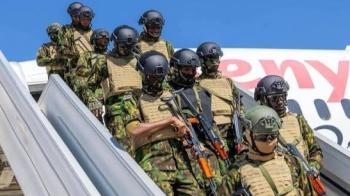
The modern security architecture currently deployed across Port-au-Prince operates under a heavily subsidized public relations illusion. The global establishment routinely presents the Multinational Security Support (MSS) mission as a benign, stabilizing force sent to rescue a host nation from localized law-and-order collapses.
This narrative is structurally false. As an operational practitioner who has managed security force assistance, foreign internal defense (FID), and asymmetric stabilization campaigns across volatile theaters, the tactical geometry on the ground dictates a far more cynical reality.
The MSS deployment is not designed to achieve a decisive military victory, secure the human terrain, or establish a sustainable domestic peace. It is an operational tool engineered precisely to maintain a state of managed chaos and low-intensity instability. By giving the superficial appearance of a stabilization operation, external managers conceal what is, in fact, an active destabilization campaign. By keeping the theater in a permanent feedback loop of structural paralysis, external managers successfully freeze the political board, protect an unrepresentative proxy government, and prevent the emergence of a truly independent, self-governing state.
2. The Operational Blueprint for Engineered Attrition
To understand why the MSS mission breeds instability by design, one must analyze its deliberate, calculated structural deficiencies. No military planner in Washington, Ottawa, or Nairobi genuinely believes that a fragmented, underfunded force of roughly 400 to 1,000 Kenyan police officers and peripheral Caribbean troops can pacify a dense urban labyrinth dominated by a unified irregular coalition holding 85% of the physical terrain.
These security forces have zero mathematical chance of creating a stable environment for Haiti or Port-au-Prince. The mission is intentionally starved of the structural requirements for victory:
- The Intelligence Blindspot: The MSS operates as an isolated, foreign-backed entity confined to armored green zones. It possesses zero community trust, meaning it has no human intelligence (HUMINT) network. It is operationally blind on the battlefield, unable to distinguish active partisans from the surrounding population.
- The Garrison Deficit: In irregular warfare, a conventional force must possess the boots on the ground to permanently clear, hold, and build. The MSS lacks the numbers to garrison a single neighborhood, let alone a capital city. They launch highly publicized, short-duration kinetic patrols that immediately withdraw back to base, creating a tactical vacuum that street networks instantly re-occupy.
- The Failure of Symmetric Firepower: Conventional interventions rely on heavy armor and centralized command structures. This strategy completely collapses in the labyrinthine quarters of Port-au-Prince, where decentralized, highly mobile defensive networks utilize high-mobility hit-and-run tactics, barricades, and sniper operations to render foreign armor obsolete.
This setup is not an accident of bad planning—it is a calculated equilibrium. The force is scaled precisely to be strong enough to protect foreign embassies, secure green-zone technocrats, and interdict maritime migration pipelines, but intentionally too weak to ever decisively defeat the irregular coalition or pacify the terrain.
3. The Somalia Parallel: The Logic of Asymmetric Failure
The flawed strategic premise of this deployment is perfectly exposed by its own institutional justification. When external planners defense-vetted the Kenyan deployment to Port-au-Prince, they heavily relied on a public narrative praising Kenya's extensive experience fighting Al-Shabaab in East Africa.
However, raw military logic dictates a completely contradictory conclusion. Look at the map: Al-Shabaab is still there. They have not been defeated on Kenya's own borders after more than a decade of heavy military intervention, cross-border counter-terrorism operations, and international ATMIS mandate funding.
An embedded armed non-state actor is an irregular force, whether you label them an ideological insurgency in Somalia or a "criminal gang" in Port-au-Prince. Their underlying operational mechanics are identical:
- The Shared Irregular DNA: Both Al-Shabaab and the Viv Ansanm coalition operate as population-centric networks whose primary weapon is not their rifles, but their organic relationship to the surrounding territory. They live within these demographics, run localized parallel taxation models, and utilize the neighborhood population as an absolute intelligence shield.
- The Blind Borderland Repetition: When foreign conventional forces attempt to deploy into the labyrinthine urban corridors of Port-au-Prince, they commit the exact same doctrinal errors seen in the borderlands of East Africa. Operating as isolated outsiders out of armored boxes, they possess zero human intelligence lines. If an intervention force lacks the intelligence infrastructure and grassroots community alignment to crush an asymmetric threat in its own backyard, it stands zero chance of pacifying a foreign urban stronghold.
4. The Grassroots Inversion: Why Top-Down Missions Fail
The fundamental flaw killing the current intervention model is the absolute institutional refusal to accept the baseline law of unconventional warfare: true stability must begin at the grassroots level.
As this is a low-intensity conflict, conventional metrics of victory are completely irrelevant. Low-intensity operations are entirely population-centric wars of attrition where the human terrain dictates the tactical ceiling. The MSS and its accompanying Global Security Framework (GSF) are working entirely from the top-down, focusing their assets on reinforcing elite, unrepresentative state structures while completely lacking local community support.
Having direct operational knowledge of these specific friction points—including the strategic and systemic failures that structurally compromised the UN MINUSTAH mission—it is clinically evident that when an external security apparatus isolates itself from the populace, the mission fails automatically.
This operational axiom was hammered home during my three combat rotations in Afghanistan serving on a Special Forces Operational Detachment Alpha (ODA). Whether operating in the dense urban terrain of Port-au-Prince or the rural villages of Kandahar, the physics of low-intensity conflict do not change. Conducting extensive train, advise, and assist missions with the Afghan National Police (ANP) and the Afghan Local Police (ALP) proved that community support is everything.
Without grassroots alignment, an intervention force becomes a foreign body that the local environment will naturally reject. If the population refuses to cooperate, provide actionable data, or co-sign the legitimacy of the security presence, the conventional force cannot hold territory. By operating from the top-down and treating a low-intensity conflict as a standard kinetic cleanup, foreign managers ensure that the tactical theater remains trapped in continuous stasis.
5. Protecting the Proxy: The Attrition Loop of the Executive Veto
The primary strategic utility of this engineered instability is to provide an operational shield for an unrepresentative, foreign-vetted executive elite. Currently, the country operates under the de facto governance of Prime Minister Alix Didier Fils-Aimé, an executive kept in power not by a domestic ballot, but by the explicit coercion of the Core Group.
The causal relationship between the security crisis and political continuity is absolute: the longer the destabilization campaign continues, the general elections simply will not occur.
If the streets of Port-au-Prince were truly stabilized and peaceful, the international justification for an unelected Transitional Presidential Council (TPC) or a hand-picked Prime Minister would instantly vanish. The populace would naturally demand immediate, uncompromised general elections and a return to constitutional rule.
Therefore, the low-intensity violence must be sustained as a perpetual administrative pretext. Whenever the domestic population demands an authentic transition, the establishment points to the ambient street violence as "proof" that the host nation is fundamentally incompetent to manage its own affairs. This ambient instability is the very fuel that keeps the proxy government alive. By ensuring the security environment remains permanently fractured, external managers successfully delay genuine democratic processes indefinitely. The calculated fallout is that the current Prime Minister stays in office indefinitely, exercising state power without ever facing a legitimate, sovereign election.
6. Weaponizing the "Boogie Man": Foreclosing Diplomatic Runways
The clearest proof that the MSS framework is designed to preserve instability is the absolute, rapid suppression of any viable diplomatic alternative.
On January 2, 2025, the unified local coalition Viv Ansanm attempted a significant strategic shift, explicitly offering a low-level conflict dispute resolution framework, a ceasefire, and the formation of a formal political party to seek a power-sharing transition. Local elements within the host nation’s council recognized the terrain math and were prepared to negotiate to save lives.
External managers immediately panicked. Washington promptly dropped Foreign Terrorist Organization (FTO) and Specially Designated Global Terrorist (SDGT) labels on the coalition.
This was a pre-emptive administrative veto. By branding the de facto holders of the territory strictly as "irrational criminals" the Core Group legally bound the hands of the local government, making it an international financial crime to engage them in dialogue or allow them onto a ballot. The establishment polices the semantic terrain because they are terrified of a realpolitik domestic settlement. They need the "Boogie Man" to remain armed and active in the streets to justify the continued presence of foreign proxy forces and the preservation of an unconstitutional state apparatus.
7. The Geopolitical Calculus: Proxies and Great Power Competition
On a macro-strategic level, the enforcement of permanent stasis across the human terrain is heavily compounded by contemporary great power competition.
China’s expanding diplomatic footprint and maritime investment strategies within the Caribbean basin have driven the United States to implement aggressive regional countermeasures. Within this geostrategic calculus, a completely stable, independent, and sovereign Haitian state represents a massive wildcard. A truly self-governing government might choose to forge economic or logistical alliances outside the Western orbit, threatening Washington's absolute regional hegemony.
The MSS deployment solves this problem for the Western policy establishment. By outsourcing the boots on the ground to a revolving door of international security proxies, Washington maintains an indirect, heavy-handed imperial veto over the country's maritime borders, ports, and critical logistics corridors. The resulting instability functions as a geopolitical buffer zone—ensuring the country remains too fractured, dependent, and broken to ever exercise true independent statecraft or consolidate autonomous authority.
The Cold Bottom Line
The historical data dictates an unyielding operational conclusion: the global system does not want a solution in Haiti; it wants a garrisoned containment zone.
From the U.S. Marine occupation of 1915 to the decade-long stabilization architecture of MINUSTAH, straight to the modern administrative theater of the Core Group, the blueprint has never changed. The international apparatus deliberately dismantles independent domestic defense capabilities, builds unconstitutional puppet structures, and deploys operationally blind security missions to police the resulting chaos.
The newly published electoral calendar setting a vote for late 2026 is an empty administrative illusion. No election will ever be humanly possible under these parameters because the foreign security apparatus is structurally incentivized to preserve the violence. Until the external architecture lifts its imperial vetoes, abandons its sanitized briefing books, and allows an uncompromised internal negotiation among the actual stakeholders of the terrain, the populace will continue to act as the primary shield for its own survival, while the manufactured theater of foreign intervention continues to swallow the territory in engineered paralysis.
Posted August 2, 2026