


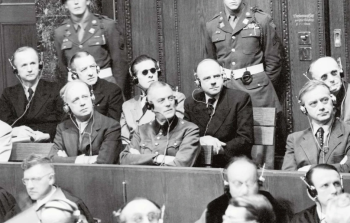
Top Nazi leaders faced war crimes trials after the Second World War but many others who took part in the Holocaust went unpunished. The Canadian government is examining whether to release a list of 900 alleged Nazi war criminals that was compiled in 1986 by the Deschênes Commission. PHOTO COURTESY OF THE U.S. NATIONAL ARCHIVES (RECORD GROUP 238 / NAID 540127), PUBLIC DOMAIN
By David Pugliese, Ottawa Citizen, Sept. 3, 2026
A judge has ordered the release of federal records on an American initiative to settle Nazi war criminals in Canada after ruling there is no evidence that making the files public would harm relations between the two nations.
The records involve a U.S. program set up after the Second World War to secretly settle large numbers of Nazi war criminals in Canada, often with the support of Canadian officials.
Jewish advocacy group B’nai Brith Canada took the federal government to court after receiving a censored copy of a report written for the 1985 Deschênes Commission on Nazi war criminals. That study, called the Rodal Report, discussed a secret U.S. government program to resettle Nazis and Nazi collaborators in Canada by evading proper security screenings.
The federal government declined to release the documents under the Access to Information law, claiming the records would harm U.S.-Canada relations at a time of ongoing tension.
But Federal Court judge Simon Fothergill concluded that claim was unsupported by any evidence. “A bald statement of ongoing ‘tensions’ between Canada and the United States is not a sufficient basis to refuse disclosure of very specific information related to efforts by the United States to resettle suspected Nazis and Nazi collaborators in Canada following World War II,” he wrote in a Sept. 1 ruling.
The decision to withhold the information was unreasonable and the records must now be disclosed, Fothergill concluded.
Similar information had already been released years ago by the Central Intelligence Agency, which ran the Nazi resettlement program, as well as the U.S. government.
After the war, U.S. intelligence agencies recruited Nazis and Nazi collaborators, many from eastern Europe, for their covert operations against the Soviet Union.
Fothergill noted in his ruling that the study written for the Deschênes Commission concluded “inadequate security screening led to many perpetrators of Nazi war crimes entering Canada.” He also pointed out the study concluded Canada was reluctant to prosecute such war criminals.
Canada has long been seen as a haven for Nazis and their collaborators, including large numbers of Waffen SS soldiers. There are a number of monuments in Canada to the Waffen SS.
In 2024, the Ottawa Citizen reported that the Department of Canadian Heritage was told that more than half of the 550 names on the Memorial to the Victims of Communism should be removed because of potential links to the Nazis, questions about affiliations with fascist groups, or an overall lack of information about links regarding such individuals or organizations. A report to the department determined that 50 to 60 of the names or organizations were likely directly linked to the Nazis, according to documents obtained by the Ottawa Citizen through an access-to-information request.
Richard Robertson, B’nai Brith’s director of advocacy, says it is difficult to understand why the Canadian government still continues to withhold its Nazi files. “For a country that fought against Nazi Germany, to be so hesitant to come with terms and release to the public its Nazi past so we can learn from this dark history, is perplexing to say the least,” he said.
Robertson is hopeful the public will get a better understanding why the government had agreed to the Nazi resettlement program after the war. “This is a victory for all Canadians,” he said. “This is information that all Canadians deserve to have made accessible.”
But he said his organization would not let up on its quest to pry loose more records.
“B’nai Brith is committed to ensuring that all the currently undisclosed information in regards to Nazi war criminals entering Canada is made available to the public,” Robertson said. “We will continue to advocate for the release of the full Rodal Report and of the Deschenes Commission part 2 report which is not publicly available.”
Ottawa was “forced” to establish the Commission of Inquiry on War Criminals, headed by Mr. Justice Jules Deschênes, in February 1985.
Much of the renewed debate around Nazi war criminals and collaborators in Canada was prompted by a September 2023 event in which MPs of all parties gave two standing ovations to Yaroslav Hunka, a resident of North Bay, Ont. Hunka was described by then-House of Commons Speaker Anthony Rota as a hero and he was thanked for his military service.
But news quickly emerged that Hunka had served in a Ukrainian Waffen SS unit which fought for the Nazis. Large numbers of soldiers from a Ukrainian Waffen SS division came to Canada after the war.
The Polish government and Jewish groups have denounced the Ukraine SS unit for its role in killing civilians and its involvement in massacres during the Second World War. The division was also used by the Nazis to crush a national uprising in Slovakia, again prompting allegations of war crimes.
But some Ukrainian nationalists see the SS soldiers as heroes because they fought against the Soviet Union. The Canadian Institute of Ukrainian Studies at the University of Alberta in Edmonton continues to maintain eight endowments in the names of Ukrainian SS veterans.
David Pugliese is an award-winning journalist covering Canadian Forces and military issues in Canada. To support his work, including exclusive content for subscribers only, sign up here: ottawacitizen.com/subscribe
Posted Oct. 16, 2026