


By Widlore Mérancourt, Ayibopost, Oct. 24, 2026
The Gang Suppression Force (GSF) has received human remains that it is currently working to identify in order to determine if they belong to the four of its soldiers who have been missing since last Sunday, AyiboPost has learned. The identification process will involve taking dental impressions and will take time due to the condition of the remains, which were received from a local humanitarian organization.
The president of El Salvador, Nayib Bukele, stated on X this Saturday that the remains handed over do not belong to his four aeronautical engineers. According to Bukele, they correspond to "a child, a man of considerably greater stature than our aeronautical engineers, and a person who was wearing part of a uniform from an army that is not ours."
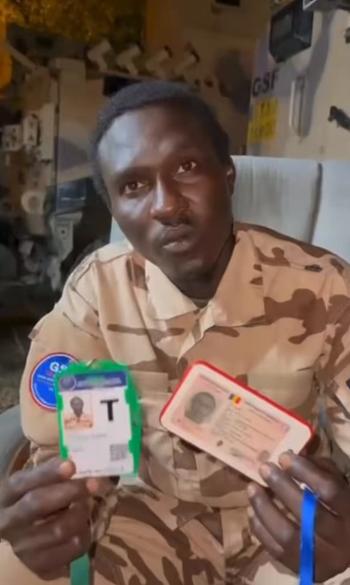
"Among the remains, identification books and military uniforms from other countries were also found," the president continued in his publication, which included the identification photo of Sossal Kamis Alhadj, a Chadian member of the FRG.
Alhadj is not dead, AyiboPost has learned. The soldier was, however, wounded during operations this week. It is unclear why the Salvadoran president released his identifying information, which was likely recovered at the scene of the operations.
The four Salvadorans disappeared in Santo last Sunday after buying food at a supermarket. A source familiar with the events maintains they were not on an official mission. According to this source, they likely got lost and found themselves without support in the heart of a territory controlled by bandits.
AyiboPost contacted another source familiar with the events in Croix-des-Bouquets, in the stronghold of the Chen Mechan gang, accused of launching the attack against foreigners.
According to her, the white Toyota all-terrain vehicle caught fire and the Salvadoran technicians, members of the "Liberty II Task Force," died. She said they were burned alive at the scene during a firefight with local bandits who were confronting reinforcements sent to rescue the technicians.
According to this source, the Salvadorans never left their car, contrary to claims in a press release issued by the Salvadoran armed forces last Monday. They were, according to the source, burned alive inside the vehicle.
AyiboPost is unable to independently confirm this version of events. Our media outlet has learned that operations to locate FRG members are ongoing.
More than two hundred members of the Salvadoran special forces landed in Haiti this week to support the efforts of the Haitian National Police and the more than 2,000 members of the FRG, AyiboPost has learned.
For Romain Le Cour, who heads the Haiti Observatory within the Global Initiative Against Transnational Organized Crime, this crisis marks a turning point for the FRG, a force whose deployment remains incomplete despite the authorization granted last year by the United Nations to increase its numbers to 5,500 members.
According to Le Cour, the deployment of the force had so far followed a timetable largely dictated by logistical constraints and political negotiations. "The process was slow, but it was moving forward," he summarizes.
However, the current crisis has disrupted this trajectory. The FRG now finds itself in a reactive position and confronted with what Romain Le Cour describes as a tactical trap.
In Santo, the FRG now operates alongside the Task Force, a structure that brings together the National Police and the private military company Vectus Global and which notably conducts drone strikes. For Romain Le Cour, this overlap of responsibilities raises questions. "This confusion of roles raises questions of accountability and respect for the rules of engagement," he believes.
Meanwhile, the security crisis continues to worsen in Haiti. At least 5,700 people have been killed or injured by gangs or in operations against them this year, up to September 11, UN High Commissioner for Human Rights Volker Türk reported this month. More than 230 people have been abducted and over 1,000 women have been victims of sexual violence.
Speaking before the United Nations Human Rights Council in Geneva on October 2, Volker Türk nevertheless stressed that the real death toll was probably much higher.
In this context, Dominican President Luis Abinader indicated on Saturday that he had spoken with his Salvadoran counterpart, Nayib Bukele, about logistical cooperation and intelligence sharing related to operations against criminal groups in Haiti. In a post on X, he stated that Dominican authorities were closely monitoring the evolving situation in the country, reiterating that their priority remained securing the border and protecting the Dominican population.
In its press release on Monday, the Salvadoran armed forces stated that the four aeronautical technicians were ambushed by heavily armed criminal groups as they returned to their camp in an armored vehicle. The forces maintain that the assailants used firearms and explosives, leading to fierce fighting and the vehicle being set ablaze. According to this version of events, the four servicemen managed to escape the armored vehicle before reinforcements arrived.
The statement indicates that Salvadoran army helicopters were deployed to support operations and repel armed groups. The aircraft themselves reportedly came under fire and sustained bullet impacts during the mission.
Three days after the Salvadorans disappeared, the president of El Salvador, Bukele, announced the launch of a military operation to find them.
“We have only one goal: to bring our four compatriots home alive and well,” Bukele said, while issuing a warning to the armed groups he held responsible for their abduction. “Today’s attack is nothing compared to what will happen if you do not return the four hostages alive,” he added, stating that Salvadoran authorities were prepared to escalate their response.
Posted Oct. 27, 2026