


By Renel Exentus, Rezo Nodwes, Oct. 26, 2026
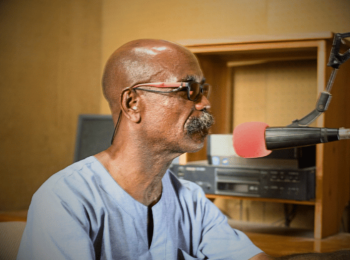
On Sunday, October 18, about a month after his assassination, Vancol Willard's family and fellow activists gathered in Montreal to celebrate the activist's life and political journey.
This tribute took place at the community organization Maison d'Haïti, from 2:30 p.m. to 5:30 p.m. The scenography of the event had been carefully designed to reflect the solemnity of the occasion: the works of the "Dressed in power" exhibition resonated with the continuous projection of photographs retracing Vancol's life.
The seating arrangement, structured around tables, fostered a dynamic of collective reflection and communion. Furthermore, the setup incorporated a hybrid dimension through live streaming via the Google Meet platform, allowing remote participants to fully engage in this memorial space, seamlessly alternating with the visual representations dedicated to the deceased.
Under the direction of activist Chantal Ismé, the ceremony opened with the strains of the iconic song "The Internationale ," a symbol of the struggle for a classless society founded on social justice and the equitable distribution of public resources. In turn, relatives and comrades of Comrade Vancol spoke to honor the memory and commitment of the deceased comrade.
His daughter, Malaika, opened the tributes by recalling her father's absolute devotion to popular causes. It was precisely because of this commitment that he was abducted from the premises of the Institute of Technology and Animation (ITECA) in Gressier on August 20, 2026, before being cowardly murdered.
Faced with this tragedy, the young orphan vehemently denounced the inaction of the Haitian authorities, questioning the responsibility of a state in the face of such tolerance of crime within society. This question resonated deeply and powerfully with the audience.
The other speakers did not pursue the question of state inaction. Instead, they focused on the life of Willard Vancol. For in such circumstances, it was out of the question to let sadness overwhelm us to the point of forgetting the man he was. It was in this sense that Michel Thomas compared Vancol to Ikonnikov, the central figure in Vasily Grossman's novel, Life and Fate (1980). Imprisoned in a German concentration camp, Ikonnikov categorically refused to participate in the construction of the infrastructure intended for mass extermination.
This refusal was an expression of subversive kindness, consisting of avoiding participation in evil, even at the cost of one's own life. By drawing this parallel, Thomas wanted to show that Vancol was of the same mettle as those who do not hesitate to face their ultimate fate to defend their principles. His assassination near his workplace testifies to this courage.
Taking the microphone, Georges Eddy Lucien emphasized Willard's contribution to preserving the memory of popular struggles in the country. He noted that Willard, along with his comrades from the People's Unity Movement in Les Cayes (MUPAC), initiated the commemoration of the 1929 Marchaterre massacre in the city of Les Cayes. This work continued with his participation in the creation of community radio stations, particularly in Les Cayes and Gressier.
Pierre Richard, James Darbouze, Samia Salomon, and Fausler Ulysse highlighted Vancol's unwavering commitment to providing a space for expression and visibility to marginalized and excluded segments of Haitian society. In this context, the establishment of community radio stations, combined with the structuring of peasant organizations and popular movements, constituted, in his view, a set of essential tools for realizing this imperative of social emancipation.
Furthermore, Fausler Ulysse recounted his collaboration with Vancol during the creation of the library at the Institute for the Promotion of Educational and Cultural Development (IPDEC), describing him as a man of great open-mindedness, resolutely committed to cooperating with the youth of his community. Moreover, Clairvil Frantz highlighted Vancol's leading role within the popular movements demanding structural reforms in the aftermath of the fall of Jean-Claude Duvalier's dictatorial regime.
As the leader of the National Association of Popular Organizations (ANOP) for the South-Grand'Anse region, Vancol established himself as one of the spearheads of socio-political demands during the pivotal period of 1988-1990. After the dissolution of ANOP, he was among the few activists of the popular cause to maintain an uncompromising ideological line, refusing to compromise his political convictions in the face of the neoliberal and fascist orientations of the governments of the last three decades.
In the same vein, the head of ITECA, Chenet Jean Baptiste, noted that his relationship with Vancol had at least three dimensions: friend, collaborator, and revolutionary activist. After working with him for nearly two decades, he characterized his activism as "open radicalism." This implies that Vancol engaged in struggles for social change that addressed the root causes of class-based society's problems. In doing so, he always demonstrated great dedication to organizational tasks and profound humanity in his interactions with the most vulnerable. Chenet Jean Baptiste also emphasized that the fight for justice for his comrade Vancol will be a significant undertaking for ITECA.
These testimonies, of great heuristic value, were punctuated by musical and poetic interludes, conceived as vectors for understanding Vancol's existential and political trajectory. Indeed, the melodic and textual apparatus rigorously responded to the requirements of his own aesthetic orientations.
Through technical mastery and remarkable sensitivity, the artists perpetuated Vancol's spiritual presence throughout the commemoration, creating a dialectical link between sound texture and poetic prose.
As an illustration, the vocal contributions of Réginald Germain and Malik, combined with the measured lyricism of Jean Masséna, embodied a fruitful symbiosis between the musical and literary registers. By reinterpreting, in their own way, the traditional polyrhythms of Haitian popular culture—such as yanvalou , petro , and mayi —they imbued this tribute with a profound resonance, both in terms of memory and aesthetics.
The significance of the event for the struggles in Haiti
It goes without saying that such an activity is of great importance to the family and friends of the deceased. By collectively remembering the life of our comrade, we are trying to create the conditions for his assassination to be recognized. This recognition will gradually allow us to grieve and better equip ourselves to continue the long struggle for justice.
However, in Haiti, where Vancol was murdered, not everyone has the opportunity to honor the passing of a loved one. Gathering to pay respect after someone's death is nearly impossible in many parts of the West, Artibonite, and Central Plateau departments.
We know that MUPAC members paid tribute to Vancol's memory in the city of Les Cayes with a funeral vigil on September 18, 2026. It is not easy to do the same in departments where gangs kill on a daily basis.
In Haiti, the right to mourn is on the verge of being destroyed. During the period when Willard was kidnapped and then executed, at least three massacres bloodied the country: in Kenscoff, Gressier, and the Artibonite region. The provisional death toll, according to available data, is around 300 dead and missing.
In most cases, silence and reflection are forbidden to the victims' families, who are condemned to live day to day in the constant fear of fleeing to avoid becoming the next targets of the gang coalition. Reports from human rights organizations converge: the daily lives of a large segment of the population are now dictated by the visceral terror of dying at the hands of the gangs.
Far from being accidental, this terror has become a veritable political commodity. The authorities are using it to maintain their grip on power, while numerous political parties and civil society organizations are taking advantage of the crisis to demand their share of state privileges, freeing themselves from any electoral legitimacy.
Like the fascist regimes of the past, fear has become the dominant mode of governance in Haiti. While power is not openly aligned with gangs, the latter paradoxically legitimize its existence. This toxic atmosphere is destined to persist as long as it serves powerful political interests, since restoring security would spell the end of the status quo.
Faced with this impasse, Comrade Vancol's thinking offers a key to breaking the deadlock. Through their testimonies, several speakers emphasized Vancol's faith in the capacity of the oppressed classes to overthrow the established order and build an egalitarian society.
This conviction applies equally to the security crisis: only the mobilization of the working classes will allow us to wage a genuine struggle to restore security in Haiti. It is by resolutely embracing this perspective that we will honor the memory of our comrade Willard Vancol.
Posted Oct. 28, 2026