


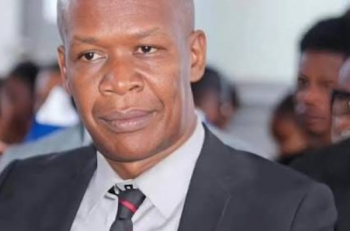
By Aristilde Deslande, Vant Bèf Info, Oct. 8, 2026
His career is marked by high public exposure. He is also the target of criticism from human rights organizations and the United Nations.
From the judicial system to the Nippes
Jean Ernest Muscadin is a lawyer and public prosecutor. He served as deputy government commissioner before becoming government commissioner himself.
He was then appointed head of the prosecutor's office at the court of first instance in Miragoâne, in the Nippes department.
It was in this role that he became known to the general public. His work focused on combating armed groups and securing roads in the Great South.
Muscadin adopted a particularly firm stance against gangs. He notably declared that his jurisdiction would be a "graveyard for bandits".
He also made his presence felt in the field during operations and traffic stops. This presence helped build his public image as a magistrate directly involved in the fight against crime.
Highly contested methods
However, Muscadin's actions are the subject of serious accusations.
In a report published in November 2024, the National Network for the Defense of Human Rights (RNDDH) attributed at least 20 alleged summary executions to the organization. The organization stated that those killed were subsequently presented as members of armed groups or individuals involved in criminal activities.
The report also indicates that the then Minister of Justice and Public Security, Emmelie Prophète Milcé, sent him a letter of reprimand in December 2023. She accused him, in particular, of establishing his own rules outside of legal norms.
The United Nations has also documented accusations against the Miragoâne police commissioner. In its human rights report for the second quarter of 2026, BINUH indicates that no legal proceedings had been initiated against Jean Ernest Muscadin for his alleged involvement in at least 76 documented summary executions between 2022 and 2025.
These accusations do not amount to a judicial conviction. However, they constitute an important element of his public career.
A popularity built on security
Despite these criticisms, Muscadin has enjoyed support in several sectors of the population, particularly in the Great South.
International reports have noted this popularity. A request for information from the Immigration and Refugee Board of Canada, citing sources from the United Nations and the Global Initiative Against Transnational Organized Crime, reports that Muscadin enjoyed significant popularity despite accusations against his methods.
His speech is primarily based on security. He advocates strong action against armed groups and affirms his desire to restore the authority of the state.
This position is now one of the main elements of his political image.
From Miragoâne to the presidential election
On September 14, 2026, Jean Ernest Muscadin confirmed his intention to participate in the presidential election. FC Nantes agreed to support his candidacy.
On September 30, his name appeared on the platform of the Provisional Electoral Council (CEP) among the candidates registered for the presidency under the banner of the FCN.
This registration, however, does not constitute final validation of his candidacy. His application must still be reviewed by the electoral authorities.
An administrative situation to be examined
Muscadin's candidacy comes while he is still serving as government commissioner of Miragoâne, according to available information.
The 2026 electoral decree sets out specific conditions for public prosecutors wishing to run for office. Article 153 notably includes requirements regarding their resignation and the supporting documents they must provide.
The administrative situation of Muscadin will therefore have to be examined within the framework of the electoral procedure.
Registration on the CEP platform does not guarantee a final decision on the admissibility of the application. The verification and appeal period allows the electoral authorities to rule on the various candidacies.
Security at the heart of his project
Since announcing his candidacy, Muscadin continues to place security at the center of his discourse.
He advocates for a firm response to armed groups. He also calls for strengthening the resources of the Haitian National Police.
His move from the prosecutor's office to national politics now raises a broader question: how to transform a local experience of fighting insecurity into a national governance project?
This candidacy thus places Jean Ernest Muscadin before several challenges. He will have to present his vision of security, but also his positions on the economy, institutions, justice, international relations and other areas of public policy.
His career has also been marked by accusations of summary executions made by human rights organizations and the United Nations.
Jean Ernest Muscadin thus enters the presidential race with a career built around justice and security. His candidacy marks a new stage in his public career. It also places his record at the Miragoâne prosecutor's office and his methods for combating armed groups at the heart of the national debate.
Posted Oct. 19, 2026